
Build Your Dream Career in Aviation
Celebrate Independence Day by taking the first step toward your aviation career. Explore cabin crew and ground staff training, aviation careers after 12th, and career preparation at Skyrange Academy.
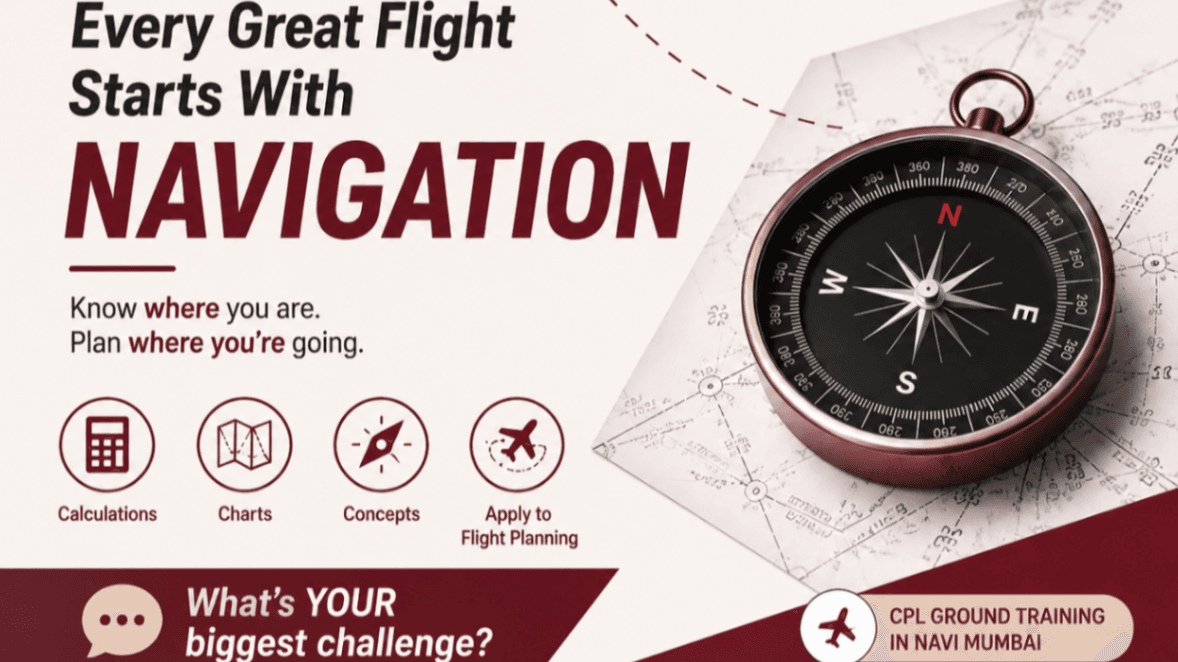
If you are preparing for a Commercial Pilot Licence (CPL), Air Navigation is one of the most important subjects you will study during your CPL ground training. Navigation teaches you how to understand where an aircraft is, where it needs to go, and how to plan a safe and accurate route.
For many student pilots, Navigation can initially seem difficult because it involves charts, calculations, directions, distances, and flight planning. However, once the basic concepts are understood, it becomes much easier to connect the theory with real-world flying.
Air Navigation is the process of determining an aircraft’s position, direction, distance, and route during a flight. A pilot needs to know more than just the departure and destination airports. They must understand how to plan the journey and monitor the aircraft’s position throughout the flight.
This makes Navigation an essential part of both DGCA CPL ground training and practical pilot training.
During CPL ground classes, students gradually develop an understanding of several important navigation concepts, including:
These topics help students develop the knowledge required to plan and understand a flight effectively.
Imagine flying from one city to another. Knowing your departure airport and destination is not enough. A pilot needs to understand the route between the two points and continuously have an idea of the aircraft's position.
This is where Navigation becomes important.
It helps pilots think ahead and plan before problems arise. Good navigation knowledge supports better flight planning, situational awareness, and decision-making.
For a student pilot, the goal is therefore not simply to memorise formulas. It is to understand why the calculation is being performed and how it relates to an actual flight.
Navigation can feel challenging in the beginning, particularly when students are introduced to calculations and aeronautical charts. The difficulty usually comes from trying to learn everything at once.
A better approach is to understand the concepts step by step. Once students become comfortable with basic directions, charts, distances, and calculations, they can gradually move towards more advanced flight-planning concepts.
Regular practice is also important because Navigation is a subject where understanding and application go together.
For students preparing for their DGCA CPL examinations, Navigation forms an important part of ground training. A structured learning approach can help students understand the subject instead of relying only on memorisation.
Good CPL ground training should combine theory, calculations, charts, examples, and practical flight-planning concepts so that students can see how the subject connects with aviation.
If you are an aspiring pilot looking for CPL ground training in Navi Mumbai, choosing the right ground training program can help you build a strong foundation before progressing further in your pilot training journey.
At SkyRange Academy, students can learn important CPL subjects through structured ground training designed for aspiring commercial pilots.
Want to understand Air Navigation better? Start by learning one concept at a time—and gradually learn to think ahead like a pilot.
Visit : https://www.skyrangeacademy.com/cpl-ground-training to learn more about DGCA CPL course in Navi Mumbai.
Navigation is a CPL subject that teaches student pilots how to determine aircraft position, direction, distance, and route while planning and conducting a flight.
Yes. Air Navigation is an important subject covered as part of CPL ground training and DGCA pilot examination preparation.
Navigation can initially seem challenging because of charts and calculations. However, with proper guidance, concept-based learning, and regular practice, students can become comfortable with the subject.
CPL Navigation generally involves concepts such as aeronautical charts, direction, bearings, distance, position, flight planning, time-speed-distance calculations, and navigation techniques.
Navigation helps pilots understand their position, plan routes, manage flight parameters, and make informed decisions during flight.
You can study CPL ground training at SkyRange Academy in Kharghar, Navi Mumbai. The academy offers DGCA-aligned ground training covering Air Navigation, Meteorology, Air Regulations, Technical General and RTR (A), along with exam preparation and guidance for aspiring commercial pilots.
For more Aviation & Hospitality insights, stay connected with us on LinkedIn.

Build Your Dream Career in Aviation
Celebrate Independence Day by taking the first step toward your aviation career. Explore cabin crew and ground staff training, aviation careers after 12th, and career preparation at Skyrange Academy.

The Importance of Soft Skills in the Aviation Industry
Soft skills refer to your personal attributes — how you interact with others, handle pressure, communicate, solve problems, and work in a team. These are non-technical skills but are essential in service-based industries like aviation.

✈ Your Roadmap to Becoming a Cabin Crew
Dream of traveling the world at 36,000 feet, serving smiles, and exploring new cities—all while getting paid? Cabin crew life could be your calling! Here’s your step-by-step guide to turning that dream into a boarding pass. ?✈️